
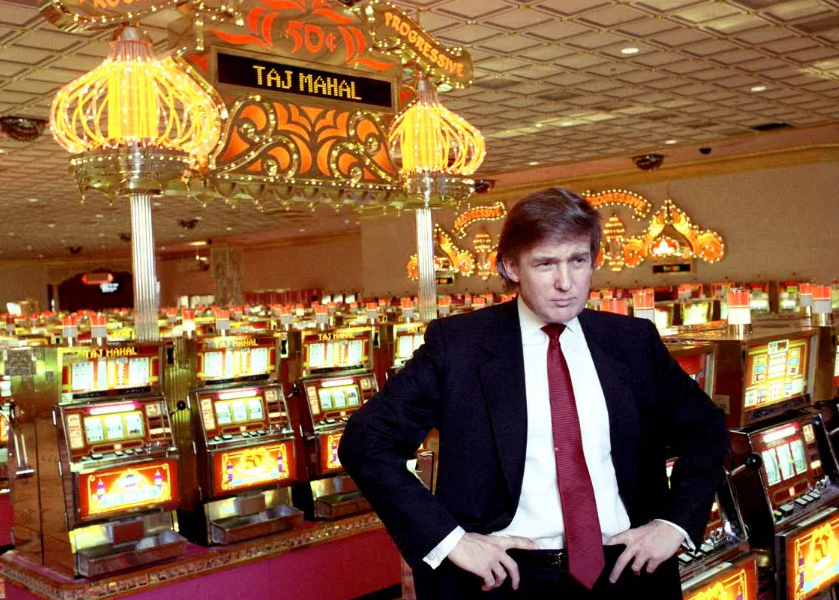
Donald Trump’s Atlantic City casino empire, once billed as a monument to US capitalism was, according to federal law enforcement records, bankruptcy filings, and U.S. Senate testimony from the 1980s and 1990s, riddled with ties to organized crime, financial misconduct, political corruption, and links to international intelligence networks.
Between the opening of Trump Plaza in 1984 and the bankruptcy of the Trump Taj Mahal in 2014, Donald Trump’s Atlantic City casinos were repeatedly flagged in law enforcement files and Senate testimony for their exposure to money laundering and proximity to organized crime. Investigations described the properties as key points of entry for illicit funds, narcotics trafficking, and political influence, operating for decades with minimal regulatory pushback and, at times, apparent political protection.
Mobbed-Up Construction and Contracts
From the mid-1980s through the early 1990s, Trump Plaza and Trump Castle were constructed using subcontractors later exposed by law enforcement as mafia fronts. One of the most notorious was S&A Concrete, a ready-mix provider clandestinely controlled by Genovese boss Anthony “Fat Tony” Salerno and Gambino leader Paul Castellano. Federal indictments revealed that S&A was awarded a $7.8 million contract for Trump Plaza, alongside numerous other Trump properties, at inflated rates, a strategy to launder money into the coffers of New York’s most powerful mafia families.
In Atlantic City, similar patterns emerged. Several construction and service contracts were tied to firms under the influence of Nicodemo “Little Nicky” Scarfo and the Bruno-Scarfo crime family, including in plumbing, electrical, and demolition trades. Internal memos from the New Jersey Division of Gaming Enforcement described the developments as “vulnerable to organized crime infiltration” and flagged “ongoing vendor risks,” yet no meaningful oversight followed. Trump’s projects advanced without delay or penalty, despite repeated warnings from regulators.
These operations were not isolated incidents of corruption, but components of a systemic structure where mob-controlled businesses blended seamlessly into high-profile development deals. The same Scarfo-linked firms operating in Atlantic City were active during a period when other real estate ventures, particularly in Ohio and New York, began showing signs of similar laundering infrastructure. Les Wexner, the billionaire retail magnate and later patron of Jeffrey Epstein, was among those whose business empire in Columbus involved shell companies and advisors flagged for organized crime ties, including individuals connected to the Scarfo network.
In the 1980s, Wexner’s personal tax attorney, Arthur Shapiro, was murdered execution-style in a case Columbus police described as “mob-related,” occurring amid rising concerns over shell entities and questionable real estate transactions tied to Wexner’s corporate structure. Internal law enforcement records and local investigative reporting raised red flags about Wexner’s reliance on advisors with deep criminal ties, most notably Jack Kessler, who was internally described as maintaining contact with La Cosa Nostra figures and later identified as having ties to the Genovese-LaRocca crime family.
In 1991, Leslie Wexner and Charles Bronfman co-founded the MEGA Group, a secretive pro-Israel donor consortium that included high-profile figures and hosted Donald Trump at private events that included Robert Maxwell, Ghislaine Maxwell and Jeffrey Epstein. Intelligence experts have described the group as a covert vehicle for Israeli influence operations in the U.S., with ties to Mossad. Jeffrey Epstein, appointed by Wexner as trustee of his foundation from 1992 to 2007, operated with sweeping control over Wexner’s wealth and surrounded himself with layers of shell companies and security practices typical of espionage operations. The group’s financial networks occasionally intersected with known laundering channels used by Russian and Israeli oligarchs, some of whom maintained organized crime affiliations such.
Trump Money Laundering
In 1990, Trump Plaza was fined $200,000 after state regulators uncovered a money laundering operation involving Robert LiButti, a known associate of the Gambino crime family with direct ties to boss John Gotti. According to regulatory findings, LiButti wagered millions of dollars at the casino using false identities and shell accounts, tactics commonly used to conceal the origin of illicit funds and evade federal currency transaction reporting requirements, also known as money laundering. The casino also faced penalties for discriminatory conduct, including accommodating LiButti’s demands to avoid Black and female dealers.
Rather than conducting enhanced due diligence or filing suspicious activity reports, Trump Plaza staff permitted LiButti to gamble freely, despite his organized crime background being well known to law enforcement and state gaming officials. The structure of the transactions, large cash bets placed through intermediaries and pseudonyms, mirrored standard laundering practices designed to integrate dirty money into the financial system via casinos. A subsequent 1992 report from the New Jersey Division of Gaming Enforcement criticized Trump’s casino operations for enabling organized crime figures to exploit the casino’s financial infrastructure. Investigators cited a pattern of compliance failures, noting that Trump properties exhibited “persistent vulnerabilities” to money laundering and financial abuse. The LiButti case was not an isolated incident.
Taj Mahal’s Repeated BSA Violations
When the Trump Taj Mahal opened in 1990, it was promoted as the most extravagant casino in the world. But by 1998, it had become a case study in money laundering. A Government Accountability Office (GAO) report identified the Taj as one of the top three casinos in America most susceptible to laundering due to its massive cash throughput and lax oversight. Regulators cited the Taj Mahal’s systemic failure to report high-value cash transactions, which are legally mandated to prevent criminal funds from entering the legitimate economy. It was cited in multiple federal enforcement actions for violations of the Bank Secrecy Act (BSA). In 1998, U.S. Treasury’s Financial Crimes Enforcement Network (FinCEN) levied a $477,700 penalty against the casino for failing to file required Currency Transaction Reports (CTRs).
The problems persisted. Between 2010 and 2012, federal regulators uncovered widespread and willful violations of AML requirements at the Taj Mahal. The casino had failed to maintain proper compliance programs, did not file Suspicious Activity Reports (SARs), and failed to flag or investigate transactions that clearly met reporting thresholds. In March 2015, the U.S. Treasury’s Financial Crimes Enforcement Network (FinCEN) imposed a $10 million fine, the largest civil penalty ever levied against a casino at the time, for what it described as “significant and longstanding violations.” According to a Treasury Department official cited by Reuters in 2015, the Taj failed to properly file suspicious activity reports for years, allowing illicit funds to pass through casino cages undetected.
Russian Mob and Intelligence Activity in Trump Casinos
FBI surveillance throughout the 1990s monitored Russian organized crime as it grew across the United States, one name repeatedly surfaced: Vyacheslav “Yaponchik” Ivankov. U.S. law enforcement identified Ivankov as a highly respected lieutenant of the Russian mafia, vor v zakone, affiliated with the powerful Solntsevskaya Bratva syndicate. Deported in 1992 from Russia, Ivankov was suspected of orchestrating extortion, racketeering, drug trafficking, and large-scale money laundering from his base in Brighton Beach. He was observed by federal agents frequenting Trump Tower and gambling at Trump’s Taj Mahal in Atlantic City. Yet despite his status, Trump’s casinos refused to flag his activities.
Ivankov and his Solntsevskaya network has been linked by European intelligence agencies to Russian state intelligence. In effect, the FSB (Putin’s successor agency to the KGB) and organized crime became increasingly intertwined throughout the 1990s, with operatives using criminal networks to conduct influence and laundering operations . The Solntsevskaya Bratva was among the most internationally sophisticated mafia groups in history, handling cross-border financial schemes and establishing footholds in Western financial hubs. Ivankov’s presence in Atlantic City shows how the Russian mafia took over traditionally Italian mafia hubs during the early 90s.
Some analysts have noted indirect parallels between Solntsevskaya operations and Epstein-style trafficking networks, particularly regarding high-end rape trafficking via luxury properties and planes. Among the Solntsevskaya Bratva’s most insidious criminal enterprises was its extensive involvement in human trafficking, child trafficking, and rape trafficking. According to law enforcement and NGO reports, the the Russian mobsters oversaw vast smuggling networks that moved thousands of women and children, primarily from Ukraine, Moldova, Russia, and the Balkans, into rape slavery across Western Europe, North America, and the Middle East. A 2006 U.S. government report estimated that at least 8,000 women and children from Slavic countries were trafficked into the United States each year at the peak of these operations.
Russian traffickers used fake modeling agencies, visa scams, and labor recruiters to force women into rape slavery, placing them in brothels, luxury clubs, and casinos. Blackmail operations thrived in private jets, VIP hotel floors, and unregulated venues. Trump’s casinos, including the Taj Mahal and Trump Plaza, were flagged for weak anti-money laundering controls and VIP loopholes. FBI surveillance confirmed Russian mob activity at these sites during racketeering probes, raising serious concerns they were used for trafficking and blackmail. Whether by design or neglect, the environment was ideal for covert exploitation and manipulation.
Upon Ivankov’s 1995 arrest in New York, agents seized his personal address book. According to investigative journalist Seth Hettena, the FBI found “a working number for Trump Tower and a Trump Organization fax machine” listed among his contacts.
Ivankov had been operating under a false identity while overseeing racketeering and extortion operations across the U.S. Despite his fugitive status, he had been living undisturbed in a luxury condominium in Trump Tower. “At first all we had was a name,” recalled James Moody, former chief of the FBI’s Organized Crime Section. “And then we found out he was in a luxury condo in Trump Towers.” FBI surveillance later tracked Ivankov frequenting the Trump Taj Mahal in Atlantic City, one of the casinos repeatedly flagged by federal regulators for money laundering vulnerabilities.
“The Trump connection raised alarms,” said a former FBI agent familiar with the case, who requested anonymity. “We don’t put mob bosses in Trump Tower by coincidence, he had contacts there.” Despite the presence of Trump Organization contact numbers in Ivankov’s personal effects and his repeated visits to Trump-owned properties, no investigation was ever opened into the nature of the relationship.
Hettena noted, “This wasn’t some street-level criminal. Ivankov reported directly to Moscow and was tied to global money laundering operations. The Trump Tower listing wasn’t incidental, it was operational.”
The Epstein Connection
Multiple elements of Trump’s Atlantic City empire intersected with Jeffrey Epstein’s trafficking and intelligence-linked operations. Both men shared a network of high-level political patrons, air transport, and access to pro-Israel donors. Wexner, who granted Epstein broad control over his financial empire, was a co-founder of the MEGA Group, a collective of powerful individuals also known to include Charles Bronfman and figures with ties to Mossad.
Intelligence analysts have long suggested that Epstein’s properties functioned as blackmail honeypots, carefully controlled environments aimed at entrapping high-profile individuals in compromising situations, which could then be used for leverage. Trump’s casinos, repeatedly flagged for weak anti-money laundering controls, unregulated VIP access, and discreet private suites, offered a similarly conducive setting for such covert operations.
Ghislaine Maxwell’s father, Robert Maxwell, was a confirmed asset of Israeli intelligence, and several Epstein associates, Ehud Barak, Leon Black, also maintained ties to individuals connected to Mossad or Russia’s FSB, according to intelligence sources and investigative reports.
State-Enabled Crime
Despite extensive evidence, efforts by law enforcement to pursue criminal charges were repeatedly stalled. Donald Trump was never prosecuted over the alleged money laundering and organized crime ties connected to his Atlantic City casinos. Regulators have since said their work was obstructed by political interference. One former New Jersey gaming official recalled, “We were told to look the other way. The message was clear.”
The overlap between organized crime, foreign intelligence with ties to Israel and Russia, and Trump’s casino operations suggests something more complex than ordinary political corruption. Some investigators believe Atlantic City may have served as an early testbed for a broader system, one built on blackmail, illicit financing, and covert influence operations with global reach.
- Barrett, Wayne. Trump: The Deals and the Downfall. New York: HarperCollins, 1992.
- United States Senate Permanent Subcommittee on Investigations. Crime and the City: Organized Crime in Atlantic City. Hearings, 1986–1992. Washington, DC: Government Printing Office.
- United States General Accounting Office. Money Laundering: Casinos and Credit Cards Pose New Challenges. GAO-03-342. Washington, DC: GAO, 2003.
- U.S. Department of the Treasury. FinCEN Fines Trump Taj Mahal Casino Resort $10 Million for Significant and Longstanding Anti-Money Laundering Violations. Press Release, March 6, 2015. https://www.fincen.gov/news/news-releases
- Hettena, Seth. Trump/Russia: A Definitive History. Brooklyn: Melville House, 2018.
- Johnston, David Cay. The Making of Donald Trump. Brooklyn: Melville House, 2016.
- Eisinger, Jesse. “Trump Casinos Fined for Money Laundering Violations.” ProPublica, March 6, 2015. https://www.propublica.org
- Unger, Craig. House of Trump, House of Putin: The Untold Story of Donald Trump and the Russian Mafia. New York: Dutton, 2018.
- Cockburn, Alexander. “Robert Maxwell: The Backstairs Billionaire.” The Nation, November 1991.
- Ward, Vicky. “The Secret Lives of Jeffrey Epstein.” Vanity Fair, March 2003.
- Mayer, Jane. “The Case of Leon Black and Jeffrey Epstein.” The New Yorker, August 2021.
- Filkins, Dexter. “The Shadow Over Leon Black.” The New Yorker, March 2021.
- U.S. House Committee on Government Reform. Russian Organized Crime in the United States. Hearing before the Subcommittee on Criminal Justice, Drug Policy, and Human Resources, 2000.
- Intelligence Online. “How Epstein’s Networks Overlapped with Intelligence Circles.” Intelligence Online, August 2019.
- Silverstein, Ken. “Leslie Wexner’s Ties to Epstein and the MEGA Group.” Observer, July 2019.
- Levine, Mike. “Trump Taj Mahal Fined for Anti-Money Laundering Violations.” ABC News, March 6, 2015.
- Rich, Frank. “The Stench of Decay.” New York Times, February 2004.
- Risen, James. “A Spy Scandal Wrapped in a Sex Scandal.” The Intercept, September 2019.
- Hosenball, Mark. “FBI Probes Russian Mafia Links to Trump Properties.” Reuters, March 2017.
- New Jersey Division of Gaming Enforcement. Reports on Casino Compliance and Vendor Risk. Various years, 1985–2015.
One response to “Inside Trump’s Atlantic City Mobbed-Up Empire”
[…] Look of the Year Trump, Who Owes His Freedom to Due Process, Is Destroying It for Everyone Else Inside Trump’s Atlantic City Mobbed-Up Empire (the intelligence agency related stuff is meh, but a very good summary of Trump’s mob […]