
When Andrew Tate, an online influencer indicted for rape and human trafficking abroad, arrived in Fort Lauderdale in February 2025, U.S. federal agents had already designated him a person of interest. Federal agents, already alerted to his presence, did not stage a dramatic confrontation. Customs and Border Protection officers did not either. They have a familiar playbook used in cross-border trafficking and organized crime cases. His phones and electronic devices were taken aside, a routine step in cases where investigators expect that the most revealing evidence is not carried in a suitcase but stored in messages, financial apps, and hidden folders.
Inside DHS, investigators began opening the forensic review almost immediately. What they found or expected to find has not been disclosed, but people involved in the early hours of the examination say nothing appeared out of the ordinary in the workflow. Then the process hit a wall.
Within days, the review was abruptly halted after a message arrived from the administration’s political side. The interruption was sharp enough that career officials began comparing notes. Something had broken the usual chain of custody, and the pressure was coming from far above the investigators handling the case.
Reports by ProPublica show that the order did not originate inside DHS. It came from the White House. Paul Ingrassia, the administration’s liaison to the department, delivered the instruction: the seized devices were to be returned to Andrew and Tristan Tate. On paper, it was phrased as a request. To the officials who read it, it carried the unmistakable tone of a directive.
Ingrassia Ethics Crisis
The choice of messenger raised immediate concern. Paul Ingrassia, who previously represented Andrew and Tristan Tate as a private attorney, was serving as the White House liaison to the Department of Homeland Security. To career officials trained in federal ethics rules, it was impossible to ignore. Federal employees are prohibited from taking actions that could materially benefit former clients, and even the appearance of such a conflict can undermine agency credibility.
Several DHS officials stated that Ingrassia’s involvement alone raised significant concerns. The request to return the devices originated from someone with a documented prior professional relationship with the subjects of an active investigation and carried the weight of White House authority. For DHS officials, the overlap between Ingrassia’s prior representation and his government role constituted a potential ethical breach, not a minor procedural issue.
Ingrassia’s appointment had already raised eyebrows inside Washington. Trump had tapped him to run the Office of Special Counsel, the federal agency responsible for policing ethics violations. That nomination imploded almost immediately after reporters surfaced a string of racist and inflammatory messages he had written in the past. The collapse should have ended his ascent. Instead, the White House shifted him into a liaison role that required no Senate confirmation and offered the kind of access normally reserved for seasoned political operatives.
It has become a regular occurrence that when a nominee faces public scrutiny or a rejection from the Senate, the Trump administration moves the individual into a position that sidesteps oversight. Ingrassia’s new role gave him a direct channel into the DHS, despite his recent controversies and his prior work as counsel for the very men at the center of the investigation. For career officials who watched these moves unfold, the message was that political loyalty had become a qualification in its own right.
Several DHS officials reported that the message raised immediate concerns. They noted that it is highly unusual for someone who previously represented subjects in an active investigation to deliver White House communications regarding that investigation. Officials believed this situation clearly crossed ethical boundaries that federal employees are expected to uphold. One official said that the context alone indicated impropriety, even before considering the sender’s identity.
The intervention did not occur in a vacuum. It landed in the middle of a well-established pattern in which Trump’s second administration involved itself in sensitive law enforcement matters, often to the benefit of political allies or individuals with personal ties to the president. Career officials who spoke with reporters said the request to hand back the Tate brothers’ devices fit squarely within that trend. They pointed to a string of contentious decisions, from high-profile pardons to public attacks on prosecutors, to the administration’s efforts to limit the release of unclassified records from the Jeffrey Epstein trafficking investigation. Seen through that lens, the push to halt a routine forensic review looked less like a bureaucratic anomaly and more like another instance in which political motives were allowed to override investigative norms and compromise federal integrity.
One DHS official told ProPublica the intervention was “so offensive to what we’re all here to do, to uphold the law and protect the American people,” Others stated that the request created pressure and an expectation that its legitimacy would not be questioned.
Trump Direct Support
Even as Andrew Tate faced trafficking and rape charges in Romania and drew heightened scrutiny from U.S. investigators, something familiar unfolded in the U.S. political media ecosystem. A cluster of Trump-aligned personalities began circling him almost immediately.
Pro-Trump commentators, streamers, and right-wing surrogates treated the Tate brothers as if they were political targets rather than defendants in a criminal case. Some echoed and amplified their claims to millions of subscribers and fans. Others downplayed the victims entirely and called their legitimacy into question. Smearing the victims and painting them as liars or ungrateful.
Some pro-Trump rewrote the case to fit their right-wing narrative and running storyline that animates pro-Trump media, where every legal challenge is framed as part of the same sprawling conspiracy against the movement. The shift happened fast.
Within hours, the ground under the story began to shift. What had entered the U.S. news cycle as a straightforward criminal case, with charges filed and evidence outlined in Romanian court documents, was already being reworked into something else entirely. In pro-Trump online spaces, the allegations did not survive long in their original form. They were reframed as an attack on Tate’s “free speech,” a phrase that appeared with remarkable consistency across platforms, as if pulled from a shared script. The shift was easy to miss if you weren’t watching in real time.
Pro-Trump influencers and podcasters picked it up, then X accounts with large followings, then high-traffic YouTube channels. TikTok edits followed within hours. Telegram channels began recycling the same fragments of narrative, pushing them into the feeds of users who had never heard a word from Romanian prosecutors.
The charges and allegations against the Tate brothers were no longer treated as evidence in a criminal case; instead, they were recast as proof that a weaponized system was hunting him. The story hardened as it spread, carried by personalities who know how to keep their audiences agitated and suspicious. By the end of the week, the voices of the victims and authorities in the Romanian investigation had almost vanished from view under the torrent of disinformation, drowned out by astroturfing and millions of pro-Trump troll farms and influence bots.
What remained in the U.S. and English speaking media ecosystem was a tired old and recycled narrative, used repeatedly by individuals in Trump’s political world seeking cover for themselves. Tate, like others in the Trump orbit, was presented not as a defendant wanted for human trafficking and rape but as another target and victim of the Western institutions portrayed as fundamentally untrustworthy. For these networks, Tate became a symbol of a movement that insists it is always under attack, and that any challenge to one of its figures must be treated as evidence of a conspiracy against them all.
Alina Habba
In January 2025, Trump attorney Alina Habba sat for a lengthy, friendly interview with Andrew Tate, and the segment quickly spread across pro-Trump media networks. Habba did not treat Tate as a defendant facing trafficking and rape charges overseas. She approached him as a victimized culture-war resistance figure, someone wronged by Western institutions.
The exchange functioned less like a legal conversation and more like a White House endorsement delivered by one of Donald Trump’s most recognizable political loyalists. Habba offered sympathy, validation, and a platform large enough to reshape how Tate’s case was perceived by millions of Trump supporters; the message was impossible to miss.
It said something deeper than a friendly interview. By appearing with Tate in that moment, Habba conveyed that Trump’s White House was extending political legitimacy to the Tate brothers through the president’s own legal team. Inside the administration and in foreign capitals, the message read as unmistakable pressure. It said that the Tates enjoyed the backing of the U.S. president, a signal with clear geopolitical implications for Romania’s investigators, courts, and government.
Dan Bongino
Dan Bongino had spent years publicly praising Andrew Tate long before he was hired as the FBI’s Deputy Director. He boosted Tate’s content, engaged with him on social media, and spoke admiringly of his online reach. At the time, those interactions were treated as routine commentary within the pro-Trump media orbit. The meaning changed once Bongino stepped into a senior federal law enforcement role.
Inside the Bureau and among foreign partners, the concern was not that Bongino had broken rules. It was the perception problem his earlier endorsements created. Romania, which was prosecuting Tate on human trafficking and rape charges, relies heavily on cooperative intelligence channels with the U.S.
Having a senior U.S. official publicly endorse Andrew Tate risks the neutrality that U.S. law enforcement relies on when working with foreign partners. It also introduced a security vulnerability that did not need to exist. Even if no misconduct occurred, the endorsement created an opening for the case to be misread or deliberately manipulated by actors who stand to gain from casting doubt on the U.S. investigative posture.
Dan Bongino did not engage with Andrew Tate simply as another commentator drifting through the right-wing online churn. It was a calculated financial decision. By the time Tate’s influence machine had grown into one of the largest toxic male-oriented ecosystems on the internet, Bongino had become a significant shareholder in Rumble.
Rumble served as Tate’s main after he was banned across major social media platforms for spreading hate-filled propaganda that encouraged real-world violence, especially against women. Bongino was not only a shareholder, but he is now also a law enforcement official with a financial stake in the company that hosted, promoted, and profited from the Tate trafficking network’s content.
His praise carried a different weight. It was not the casual approval of a talk-radio host, nor the empty amplification typical of online alliances. It was a message from inside the platform’s own power structure, a sign that one of Rumble’s most prominent investors viewed Tate as an asset worth defending. For Tate’s followers, the endorsement suggested that he had institutional muscle behind him and a platform willing to amplify his reach without any oversight.
A now-sitting FBI deputy director, through both public praise and private equity, has positioned himself inside the same online ecosystem that elevated Tate to global prominence. Which raises a question: What does it mean when a senior federal official holds a financial stake in a platform built on grievance-driven politics while that same platform shapes the information environment around a defendant in a human trafficking case?
JD Vance
JD Vance has not explicitly endorsed Andrew Tate, but his actions have signaled support that is interpreted as political pressure on Romania. In December 2025, Vance’s official X account followed both Andrew and Tristan Tate, a move intelligence observers viewed as a deliberate signal, given its timing alongside increased diplomatic concern over the brothers’ legal situation in Romania. During the same period, a senior Trump insider privately warned British officials that any attempt to extradite Andrew Tate would “go down badly” with Vance, citing “free speech” as a key issue for the vice president. Additionally, when Vance launched his TikTok presence in early 2024, his first appearance featured the Nelk Boys, an influencer group known for collaborating with Andrew Tate and promoting hyper-masculine, anti-establishment content.
Vance’s public signals of support for the Tate brothers did not go unnoticed in Bucharest. Romanian officials said the gestures were puzzling and, at times, destabilizing. What concerned them was not a single action but the pattern it suggested. To them, Vance’s moves implied that senior figures in D.C. were closely tracking the case and regarding it as politically sensitive. That perception alone was enough to complicate DIICOT’s work, adding a layer of diplomatic pressure to an already high-stakes trafficking prosecution.
Richard Grenell
Richard Grenell, former acting Director of National Intelligence and later the U.S. Special Presidential Envoy for Special Missions, took an unusual step by openly endorsing Andrew and Tristan Tate in an interview with the Financial Times. “I support the Tate brothers, as evident from my publicly available tweets,” he said. The bluntness of the remark drew immediate attention inside diplomatic and intelligence circles. High-ranking U.S. officials almost never voice support for individuals facing active criminal prosecution abroad, and certainly not in cases involving human trafficking and rape. Grenell’s statement signaled a level of political alignment that many observers considered extraordinary, and in Romania, it was interpreted as yet another sign that powerful figures in D.C. were attempting to interfere.
Grenell’s public endorsement heightened concerns within Romanian diplomatic circles regarding the political attention the Tates received from Trump-aligned figures. He repeatedly reposted and praised the brothers on social media as their legal challenges intensified.
Grenell raised the Tate case during discussions with Romania’s Foreign Minister Luminița Odobescu at the Munich Security Conference. Romanian officials considered this approach unusual. Grenell later stated he only expressed personal views and did not engage in a substantive discussion. Nevertheless, Romanian diplomatic sources told reporters they perceived the contact as political pressure related to the brothers’ legal issues.
Romanian press reported that members of the Trump administration expressed interest in the legal constraints placed on the brothers, particularly the travel restrictions imposed by Romanian courts pending trial. While U.S. administrations often advocate for citizens abroad, Romania’s anti-trafficking investigators noted the unusual nature and timing of these inquiries, which coincided with significant criminal charges and additional prosecutorial actions against the Tates.
Romanian officials emphasized the judiciary’s independence and noted that any foreign political involvement, real or perceived, complicates ongoing cases and international legal cooperation. Intelligence and diplomatic circles debated why U.S. figures with no formal connection to the case would intervene, especially given the sensitivity of human trafficking prosecutions and the potential impact on U.S.-Romanian security collaboration.
Legal scholars interviewed by journalists said that direct communication from the White House about a single evidence seizure was unprecedented. The White House does not typically involve itself in low-level enforcement actions. Such actions normally remain within the purview of DHS and investigative agencies.
Donald Trump Jr.
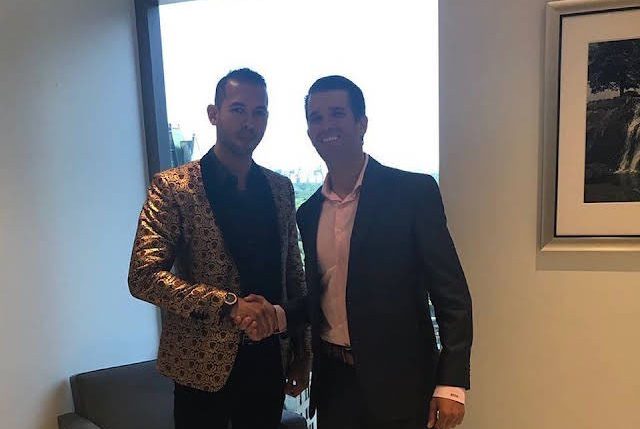
Donald Trump Jr. represents the closest and most durable link between the Trump family and Andrew Tate. People who have spent time around both men describe the relationship as more than a casual acquaintance. It took shape around 2016 and grew through repeated encounters in the same social and political circles.
They moved through many of the same cities and surfaced at private gatherings in Miami, Dubai, London, and Bucharest, usually hosted by the same small group of intermediaries who move between politics, crypto, and the influencer economy. Their circles overlapped in ways that were hard to miss. Both men kept company with figures involved in gambling technology, digital content farms, luxury branding outfits, and the expanding world of online masculinity coaching. Over time, the same names kept reappearing at the same parties, on the same boats, and inside the same back rooms where political operatives and internet personalities trade access. The pattern pointed to a relationship shaped less by ideology than by shared networks and ambition, one that placed Trump’s political orbit in close proximity to the influencer-driven ecosystem that Tate used to build his reach.
In 2024, Donald Trump Jr. joined Andrew Tate for a live conversation on X, a pairing that reverberated far beyond the usual influencer crossover. The discussion placed Tate squarely within the Trump media ecosystem, associating his online persona with one of the most politically recognizable names in the United States. Within Tate’s audience, the appearance functioned as confirmation that he enjoyed real proximity to the Trump network. It signaled that his access was not speculative or exaggerated, but validated in public by a member of the former president’s inner circle. For millions of viewers, the event strengthened the perception of a link between Tate’s digital operation and the political machinery surrounding the Trump family, giving Tate a level of implied influence that his followers treated as proof of standing within the Trump network and, by extension, a measure of political influence in the U.S. government.
Romanian media later reported that while Andrew Tate was in detention, he tried to pull on whatever threads of political influence he thought he had in the United States, including his connection to Donald Trump Jr. Investigators described a series of messages and requests in which Tate urged intermediaries to reach out to well-positioned figures in Washington. Trump Jr. was among the names he believed could shift the atmosphere around the case or stir public debate in his favor.
The outreach itself left no clear indication of whether anyone acted on his requests or whether the messages reached their intended targets. What the records do show is how Tate saw the relationship. To Tate, the association with Trump Jr. was not symbolic, and it held political leverage. If the case in Romania tightened around him, he believed that invoking those ties might change the narrative, unsettle prosecutors, or signal that he was not facing the situation alone.
His attorney denied any knowledge of these efforts, but the surviving correspondence offers a glimpse of how Tate imagined his own political relevance, especially when the pressure was highest.
The Tate influence operation
Andrew Tate operates a large, transnational digital influence network supported by a private organization known as the War Room. Tate did not rise to prominence through traditional political channels. Instead, he built a massive digital empire that blended self-help, antagonism, and a worldview rooted in grievances against women, and, portraying himself as a victim of corrupt Western institutions, he frequently presented Donald Trump as a personal model.
Tate’s rhetoric often frames legal scrutiny as evidence of political targeting, a message that resonates strongly with his followers. His online following consists primarily of young, politically disaffected men who respond strongly to anti-institutional and anti-women narratives. Such environments are highly reactive and vulnerable to manipulation, coercion, and anti-democracy operations. Cross-pollination between Tate’s ecosystem and U.S. political messaging increases the likelihood of coordinated harassment, destabilizing narratives, or rapid audience activation around sensitive political events. Russia, Israel, the UAE, and other hostile actors frequently target grievance driven male audiences similar to Tate’s demographic base. Tate’s messaging aligns with themes often used in foreign influence campaigns. His political proximity provides adversaries with opportunities to sow distrust in U.S. institutions or amplify narratives that portray Western justice systems as corrupt, and amplify wealth propaganda to diminish opposition to oligarchs, organized crime, and exploitative corporations.
The Donald Trump Jr. security risk
The political proximity between Donald Trump Jr and Andrew Tate becomes significantly more concerning when evaluated alongside Tate’s internal communications in the War Room, where he told members that he could honey trap a President if he chose to, “I could use viv to honey trap a fucking President. If I so choose. That’s an asset. Millions of dollars worth”. It is alleged that Viv is a woman from Slovakia that Tate groomed, trafficked, and raped from the age of 15 and distributed child rape media of her when she was 17 years old. Tate is charged with trafficking an unidentified minor also 17 years old. This is an indicator of an operational mindset in which blackmail, rape, or sexual leverage, entrapment, or kompromat is treated as a legitimate tool of influence. Individuals who publicly discuss coercive strategies of this type, especially in private hierarchical groups, are flagged because the mindset itself represents a national security vulnerability. It signals willingness to engage in, condone, or instruct others in methods that adversarial actors have historically weaponized during influence operations.
The concern intensifies because Tate is not isolated. He has personal connections to political figures, including members of a former U.S. president’s family. When a person with an established history of discussing sexual leverage gains social or professional access to high-profile political actors, the risk calculations for counterintelligence agencies change. Such proximity widens the potential surface area for kompromat fabrication, coercion attempts, foreign exploitation, or the inadvertent transmission of sensitive information through social pathways that lack formal security protocols.
Tate’s rhetoric also normalizes coercive thinking among his followers, many of whom admire him and view his statements as instructional rather than hypothetical. This creates an ecosystem in which lower-level actors may attempt to operationalize tactics he describes, intentionally or otherwise. This means that the danger does not rest solely in what Tate himself could do. It also lies in what members of his network might attempt or what foreign intelligence services might engineer or obtain by exploring ties between Tate and US political figures.
For these reasons, Tate’s statements inside the War Room, combined with his proximity to Donald Trump Jr., represent a meaningful national security concern. They illuminate not only a worldview but a strategic posture in which influence, leverage, and domination are framed as acceptable currency. In such contexts, political relationships become assets, reputational vulnerabilities become entry points, and foreign actors gain opportunities to manufacture or amplify destabilizing narratives.
Romania, the United Kingdom, and other allied countries rely on the United States to maintain neutrality in trafficking and organized crime cases. Tate’s perceived proximity to a former president’s family complicates these relationships. Diplomatic partners may question whether political considerations influence the U.S. posture, undermining trust and hampering cooperation in future criminal investigations.
Cybersecurity Vulnerabilities
Large online ecosystems built around anti-establishment sentiment, anti-women rhetoric, and social alienation can become fertile terrain for foreign intelligence services seeking to shape public opinion or destabilize political cohesion. The concern is not the individual influencer, but the structure of the audience they cultivate. Intelligence assessments show that foreign actors have repeatedly targeted similar male-dominated grievance communities to amplify division and undermine trust in democratic institutions. The infrastructure surrounding large online influencer ecosystems is uniquely vulnerable to intrusion, manipulation, and covert data harvesting. Andrew Tate’s enterprises, which rely heavily on subscription-based platforms, encrypted communication channels, and cross-border exchanges of digital content, sit within a cybersecurity environment that is porous and structurally risky.
Investigators familiar with trafficking networks note that exploitative operations frequently depend on insecure servers, off-the-shelf website architectures, and payment systems routed through third-party processors. These weak points allow foreign intelligence services, cybercriminal organizations, and private influence firms to intercept data, track financial flows, or manipulate content distribution. Systems involving adult content, financial transfers, and remote management of digital assets are particularly attractive targets because they generate large quantities of sensitive data while often lacking enterprise-level security controls.
In Tate’s case, much of his online revenue flowed through digital payment platforms operating in multiple jurisdictions. Romania’s anti-organized crime directorate has documented similar systems in past trafficking investigations. Without robust cybersecurity protocols, such operations create entry points that can expose victims, operators, and consumers to surveillance or exploitation. These vulnerabilities do not presuppose illicit collaboration between influencers and foreign actors. Rather, the architecture itself makes infiltration technically simple and operationally valuable for state or non-state entities.
Romania
Romania remains the geographic center of the most serious allegations against Andrew and Tristan Tate. DIICOT, the Directorate for Investigating Organized Crime and Terrorism, brought formal charges against the brothers for human trafficking, rape, and participation in an organized criminal group. According to Romanian prosecutors, the brothers lured women and minors using emotional manipulation, promises of relationships, and fraudulent opportunities for wealth creation. They coerced victims into producing explicit content for online monetization and retained control over their earnings, while using intimidation, psychological pressure, and isolation to maintain compliance.
Victim statements submitted to investigators reinforce DIICOT’s characterization of the scheme. Several women reported that they were initially approached with assurances of partnership, financial opportunity, or personal commitment. One victim told investigators that she arrived in Romania believing she was entering a relationship, only to find her movements restricted and her communications monitored. Another described a pattern of emotional pressure and gradual isolation that made it difficult to leave even when she realized that the promises she had been given were false. Another victim described a dynamic in which the environment shifted slowly from affection to control. She told investigators that after relocating, she was repeatedly discouraged from contacting her family, and that criticism or hesitation on her part was met with emotional pressure or reminders of dependence. She recalled feeling that there was “no safe path to leave.”
Others stated that they were encouraged to produce content under circumstances they did not feel free to refuse, citing fear of retaliation, humiliation, or loss of financial stability. Victims consistently reported an environment in which compliance was expected, and resistance was met with escalating emotional abuse, physical violence, or psychological pressure. One of his victims reported, “He started kissing me… and he just looked up at the ceiling and said, ‘I’m just debating whether I should rape you or not. Out of the blue he just grabbed me by the throat, smashed me to the back of the bed, strangling me extremely hard.” After the attack Andrew Tate sent her messages stating, “Am I a bad person? Because the more you didn’t like it, the more I enjoyed it.” He later wrote: “I love raping you.”
Witnesses who were not victims but spent time in the Tate properties in Romania told DIICOT that the atmosphere was “authoritarian” and “hierarchical.” One former associate reported that the brothers managed the household through routines designed to reinforce dependence and maintain emotional pressure. Another witness said that women in the house appeared anxious and hesitant to speak freely, describing the general mood as “controlled” and “supervised.” Eyewitness accounts also highlighted the role of image cultivation. Several individuals told investigators that Tate’s online persona, luxury lifestyle imagery, and social media branding were used to shape expectations and encourage recruits to trust him. Through this dynamic, the public image functioned as both a recruitment magnet and a shield against suspicion.
Victims also stated that they felt compelled to produce online content under conditions where refusal did not feel like a viable option. Some reported that they were told they were contributing to a shared business enterprise, only to later realize that they had no access to earnings or financial records. Others stated that the financial arrangements were opaque, with promises of future payments that never materialized. Andrew Tate claimed he was making £400,000 per month from webcamming and that “75 women worked for him at the peak of it all”. The conduct attributed to Andrew and Tristan Tate by Romanian prosecutors falls within the legal definition of enslavement, even though the specific charges brought by DIICOT do not state it officially.
DIICOT is the agency that handles Romania’s most complex criminal networks, including groups involved in cross-border trafficking, money laundering, sexual exploitation, cybercrime, and transnational fraud. For the agency to bring charges indicates that prosecutors believe the Tates’ alleged operation exhibits structural features typical of organized criminal enterprises operating in the region. The Tate operation mirrors structural features seen in other trafficking networks across Eastern Europe:
- Recruitment through emotional manipulation and deception.
Many organized groups recruit victims using false romantic relationships, financial promises, or invitations to work abroad in seemingly legitimate roles. DIICOT alleges that the Tates used similar deception tactics to recruit women and minors, presenting opportunities that masked the true intent of exploitation. - Centralized control is achieved through dependence or surveillance.
Trafficking groups often restrict victims’ movement, isolate them from support systems, or create financial or emotional dependency. Romanian prosecutors assert that the Tate brothers relied on coercive psychological methods to maintain control, including surveillance and manipulation. - Digital monetization through subscription platforms.
Organized exploitation networks increasingly rely on online content markets as their primary source of revenue. The Tate allegations mirror this trend, with prosecutors claiming that victims were compelled to produce online sexual content that generated revenue for the brothers. - Revenue dispersal across complex financial routes.
Criminal networks commonly distribute profits across multiple accounts, intermediaries, or offshore structures to hinder financial tracing. While investigations into the Tates’ financial pathways remain ongoing, their relocation between Romania, the UAE, and other jurisdictions reflects the mobility pattern of modern trafficking groups that leverage permissive financial environments. Indicative financial patterns include the use of shell companies registered in known tax havens and complex transaction schemes that obscure the origins of funds. Specific entities believed to be involved include offshore banks that specialize in anonymity and shell companies that facilitate layered transactions, commonly seen in these networks. - Cross-border operational mobility.
Trafficking groups often shift operations between countries to avoid detection, respond to enforcement pressure, or exploit legal asymmetries. The Tates’ movements between Romania, Dubai, the United Kingdom, and elsewhere align with this behavior pattern.
Romania’s position as a source and transit country for trafficking victims has long challenged European law enforcement. The country’s anti trafficking framework has improved over the past decade, but gaps remain in victim protection, witness security, and judicial coordination. High-profile cases, such as the Tate prosecution, test Romania’s institutional capacity and expose the system to political, diplomatic, and media pressure. This pressure intensified as individuals aligned with Donald Trump showed interest in the Tates’ case. Romanian newspapers reported outreach by political intermediaries, prompting concern among Romanian legal experts that foreign political actors might attempt to influence perceptions of the investigation. Even the appearance of political interference threatens to undermine Romania’s credibility in combating trafficking and may affect international cooperation.
The Tate case highlights an emerging trend in which influencer ecosystems intersect with criminal exploitation structures, revealing how digital personas with global followings can function as protective facades that obscure coercive operations behind curated imagery of wealth, ambition, and empowerment. DIICOT’s charges suggest that the Tates leveraged this digital architecture to normalize exploitative behavior, attract recruits, and operate a profitable yet coercive system insulated by fan loyalty and online mythology. Romanian prosecutors view the case not as an isolated digital scandal but as part of a broader criminal ecosystem in which online branding, international travel, and influencer culture provide ideal conditions for recruiting victims, exerting control, and monetizing exploitation across borders. The case also exposes a contemporary trafficking model in which coercive networks are embedded within entertainment-driven digital platforms and sustained through cross-border mobility, financial dispersion, and parasocial audience loyalty.
The case highlights the urgent need for more robust financial tracing mechanisms, stronger cross-border investigative coordination, and a deeper institutional understanding of how modern influencer networks can conceal or accelerate transnational organized crime and hostile influence operations.
Russia
Russia’s history of exploiting online communities is deeply documented. Intelligence agencies across NATO states have traced influence operations to emotional dynamics that closely mirror the psychological landscape surrounding Andrew Tate’s audience. Male-dominated spaces defined by grievance, identity conflict, and hostility toward Western institutions have repeatedly been targeted by Russian amplification strategies. Russian psychological operations, especially those run through the GRU’s cyber units and the IRA troll farm network, have consistently targeted communities where resentment, humiliation, and distrust provide ready-made accelerants. Tate’s following, which consists overwhelmingly of young men who harbor deep skepticism toward institutions and anger toward women, aligns almost perfectly with the profile that Russian operators have historically exploited.
- Grievance against institutions
- Hostility toward feminism or progressive norms
- Anger towards women
- Economic or social dislocation
- Desire for strongman archetypes
- Distrust of Western intelligence and media
Russian operations typically rely on amplification rather than creation, seizing upon preexisting content and amplifying it through networks of bots, trolls, and coordinated accounts. Tate’s viral content, which moves rapidly across platforms, fits the sort of high-velocity digital stream that such operations can easily exploit.
Russian Propaganda Amplification
Russian state media, particularly RT and Sputnik, have spent years cultivating an image of Andrew Tate as a symbolic casualty of Western decline. Their coverage routinely casts him as a man punished not for alleged crimes, but for his refusal to conform to what they describe as a failing Western moral order. In their telling, Tate becomes a vessel for grievances about censorship, a martyr standing against a system determined to silence nonconforming masculinity. Reports in these outlets frequently suggest that Romania is acting at the direction of NATO or the European Union, and that Tate’s legal troubles reflect a broader campaign to criminalize men who reject globalist social norms. It is a narrative architecture designed to undermine faith in Western justice systems by portraying them as ideologically motivated, coercive, and fundamentally dishonest. Their coverage often includes several recurring narratives:
- Tate is a victim of Western censorship
- Romania is acting under pressure from NATO or the EU
- Traditional masculinity is being criminalized
- The West targets men who resist “globalism.”
This framing dovetails seamlessly with Russia’s long-standing information strategy, which seeks to depict democratic societies as hypocritical, decadent, and internally collapsing. By holding up Tate as both hero and victim, Russian propagandists gain a convenient symbol through which to channel resentment and cynicism among young men who already distrust Western authority. In this sense, Tate becomes less an individual than an instrument, a character in a much larger story about Western disintegration and authoritarian resilience.
Tsargrad TV, a nationalist outlet backed by sanctioned oligarch Konstantin Malofeev, played an especially enthusiastic role in elevating Tate within this ideological universe. Malofeev has been tied to influence operations that target disaffected men across Europe with messaging that glorifies hierarchy, patriarchal authority, and rigid traditionalism. Tsargrad’s coverage portrayed Tate not simply as a celebrity embroiled in legal trouble, but as a cultural warrior locked in combat with Western elites. Their framing of Tate serves the dual purpose of validating anti democratic rhetoric while projecting Russia as a guardian of authentic masculinity, uncorrupted by modern liberal values.
The ecosystem of Russian propagandists extends far beyond formal state media. Freelance nationalists, far-right personalities, and digitally savvy actors have also seized on Tate’s image to advance their own ideological agendas. Figures such as Vladislav Pozdnyakov, the founder of the extremist group Male State, circulated Tate’s commentary as evidence that Western feminism and liberalism are destructive forces that suppress male power. Igor Mangushev, a mercenary propagandist active in the Donbas before his death, similarly used Tate’s statements to argue that Western institutions were collapsing under the weight of their own contradictions. Across Telegram, networks associated with Wagner sympathizers shared pro-Tate content as part of a broader campaign to undermine trust in NATO, portray Romania as a subordinate Western puppet, and elevate narratives in which the West persecutes men who refuse to conform.
What unites these actors is not coordination but convergence. They do not need direct contact with Tate to find utility in his words. His public persona, the demographics he attracts, and the emotional volatility of his audience all function as ready-made assets for propagandists looking to weaken Western social cohesion. Tate’s statements about the West’s moral decay and his open admiration for authoritarian strength blend effortlessly into Russian ideological currents that glorify force and depict democracy as corrupt and fragile. This natural alignment is why so many Russian channels repeatedly amplify his message. For them, Tate offers a cultural touchpoint through which they can push older narratives of Western collapse into newer, younger, more digitally native communities that Russia has struggled to penetrate through traditional propaganda alone.
Ukraine
Andrew Tate’s public comments about Russia’s invasion of Ukraine have raised additional intelligence and propaganda concerns, particularly because his remarks align closely with narratives favored by Kremlin propaganda outlets and personalities. Multiple outlets in Ukraine and the West have documented Tate’s statements, which often undermine Ukrainian sovereignty, diminish the legitimacy of NATO, or frame Russia as a stabilizing force rather than the aggressor. These statements create a powerful amplification channel for Russian propaganda that targets young, politically alienated male audiences.
In a July 2023 interview with Tucker Carlson, Tate suggested that “Covid went away when the Ukraine war started,” and claimed that Vladimir Putin “cured Covid.” His remarks implied that Western governments manipulated both the pandemic and the war for political gain, a conspiracy framing that tracks closely with long-running Russian disinformation intended to erode trust in democratic institutions. The Independent reported that the interview quickly circulated within online communities that already viewed Ukraine with suspicion and saw the West’s support for Kyiv as corrupt or misguided.
Ukrainian media have taken note. The outlet Novyny reported that Tate justified aspects of Russia’s military aggression and promoted a narrative asserting that Ukrainian forces were responsible for attacks on their own civilians. This accusation is a well-known Kremlin talking point designed to weaken global support for Ukraine and sow confusion among Western publics. Novyny stated that Tate’s commentary mirrored key themes of Russian psychological operations, including portraying Ukraine as chaotic, irrational, or incapable of self-governance. According to the reporting, Tate’s remarks were so aligned with Russian narratives that Ukrainian officials view him as one of the primary figures who normalizes Kremlin disinformation and spreads its propaganda among global youth audiences.
The Times separately documented that a Ukrainian refugee was found among the individuals present during a raid of properties connected to Tate’s alleged trafficking operation. While this does not relate to Tate’s political commentary, it reinforced a broader concern among Ukrainian and European advocates that women displaced by war are at heightened risk of exploitation by predatory organized crime groups.
The Kyiv Independent has also reported extensively on the role that U.S.-Trump-aligned podcasters and online personalities play in shaping anti-Ukraine sentiment among US and English-speaking audiences. Tate appears frequently within this ecosystem. His critiques of Western support for Ukraine and his portrayal of the conflict as a geopolitical distraction match the anti-Ukraine narratives spread by Russia. These media figures, by criticizing military assistance, questioning Ukrainian legitimacy, or suggesting that the conflict serves the interests of global elites rather than democratic values, help normalize Kremlin propaganda among demographics with little exposure to traditional geopolitical reporting.
From an intelligence perspective, Tate’s comments provide three key advantages for foreign influence actors.
- First, Tate commands credibility among young male audiences who are broadly skeptical of government, media, and democratic institutions. When he expresses doubts about Ukraine or questions the motives behind Western support, those sentiments carry weight.
- Second, Tate’s rhetoric aligns with existing narratives pushed through Russian state media and nationalist propaganda channels, making his content easy to integrate into broader information campaigns.
- Third, Tate’s digital footprint is vast. His high-velocity content distribution system allows foreign actors to insert, reframe, or amplify narratives with minimal friction.
These factors demonstrate how his messaging and audience structure create an information environment that foreign adversaries can exploit with ease. In this sense, Tate functions as a force multiplier for Russian influence operations. His content and persona provide ready-made material for Russian intelligence seeking to weaken Western unity, divert attention from Russian aggression, or undermine global support for Ukraine.
Within this larger picture, Tate’s anti-Ukraine messaging and influence within the Russian disinformation sphere fit into a broader pattern in which influencer ecosystems intersect with hostile influence strategies. The result is an information channel that adversarial actors can easily weaponize by opportunistically exploiting anger, distrust, and emotional volatility in online communities, encouraging targets to commit treason, crime, or participate in actions that undermine the security of their own democracies and homelands.
Israel
Israel occupies a different but related space in the global digital landscape. Its cybersecurity firms, private intelligence contractors, and digital marketing companies collectively form one of the most technologically advanced ecosystems in the world. These firms have been involved in political campaigns and commercial disputes across continents.
In several interviews, Tate has spoken favorably about Israel’s culture of innovation and entrepreneurial intensity. He has referenced the agility of its tech ecosystem and the success of its digital start-ups. These remarks appeared broadly complimentary rather than political. However, they create a point of overlap. Public affinity for a tech ecosystem specializing in influence commerce may not be operationally meaningful, but it is socially and strategically relevant for mapping Tate’s global networks of inspiration, travel, and soft influence. There is no evidence he engaged in illicit activity there. Instead, Israel appears in the conversation because of its relevance to digital influence commerce. Companies based in Israel study audience behavior, refine psychological targeting techniques, and develop tools to shape online opinion. Tate’s enormous, emotionally reactive audience shares several characteristics that such firms analyze for commercial or political clients.
Israeli marketing and behavioral analytics firms often target young, highly online male users, especially in sectors involving cryptocurrency, gaming, lifestyle branding, and ideological content. Tate’s audience fits neatly within this profile. It is a group prone to rapid mobilization, highly engaged by high-engagement content, and responsive to narratives of masculinity, grievance, and anti-establishment defiance. Israeli cyber and influence companies routinely study how online communities form identity around a charismatic figure. They analyze influencer-driven ecosystems because these spaces serve as real-time laboratories for testing behavioral triggers, optimizing targeted messaging, and refining psychological profiling tools.
Support for Hamas
Beginning in late 2023, Andrew Tate began adopting increasingly hostile language toward Israel, and his commentary quickly evolved into a package of antisemitic narratives that echoed long-standing propaganda themes used by neo Nazi movements, Russian state media, and anti-Western extremist networks. What distinguished this phase of Tate’s rhetoric was not only its substance, but its timing, its audience, and the speed with which foreign influence ecosystems amplified it.
In interviews and across his social media accounts, Tate accused Israel of committing “genocide” in Gaza. These statements, taken alone, overlap with positions held by international human rights observers. However, Tate paired that description with rhetoric that justified the October 7 Hamas massacre as a form of understandable “retaliation,” claiming that Israeli policies had created a “pressure cooker” in which Palestinian terrorism was inevitable. During a November 2023 interview, he refused to describe Hamas as a terrorist organization and instead labeled it the “masculine spirit of resistance,” language that aligned with far-right and pro-Kremlin narratives that glorify militant violence as a legitimate form of anti-globalist rebellion.
His rhetoric escalated further following the reported death of Hamas leader Yahya Sinwar in October 2024. Tate publicly praised Sinwar’s death as “heroic” and wrote that he hoped to die in a similarly “heroic” way. These statements were rapidly picked up by extremist Telegram channels tied to Russian, Israeli, and Iranian influence networks. Propaganda nodes that had previously valorized anti-Western militants found in Tate’s comments an easy vector for amplification to an audience of millions of young men.
Around the same period, Tate began circulating antisemitic tropes that questioned established historical facts about World War II and suggested that United States support for Israel was a Mossad “psyop.” He used “Jew” as a pejorative and repeatedly insisted that individuals labeled antisemitic were merely “realists,” a rhetorical move that mirrors the strategies used by extremist groups attempting to rebrand antisemitism as honest observation. In one widely shared video, Tate told his audience that “criticizing Jews in America gets you into serious trouble,” framing Jewish civic and political advocacy as a form of repression. His remarks aligned with long-standing conspiratorial narratives that portray Jews as wielding disproportionate influence within Western political systems. These narratives gain traction in part because they exploit visible geopolitical realities, including the consistent protection from accountability for crimes against humanity that Israel receives from powerful Western governments, particularly the United States, and the documented influence operations carried out by a range of Israeli lobbying, political, and business networks across allied states. While mainstream rights advocacy organizations operate transparently and within legal frameworks, authoritarian propagandists routinely distort these dynamics to create the false impression of secret manipulation, which isn’t helped by the Israeli government’s actual attempts at manipulation. Tate’s rhetoric fed directly into that distortion, reinforcing themes that have long been weaponized by extremist and foreign influence actors to undermine public trust in democratic institutions.
This barrage of antisemitic and anti-Israel messaging drew condemnation from the Anti-Defamation League and other monitoring organizations. These groups documented Tate’s rhetoric alongside his misogynistic ideology, noting that he had become a major amplifier of antisemitic talking points to a younger audience that had not previously been exposed to such narratives at scale.
Foreign influence networks do not need formal coordination to weaponize an influencer’s rhetoric. They often use a strategy known as inversion framing, in which a propagandist elevates a controversial figure who echoes a legitimate criticism, then uses that figure’s notoriety to contaminate the underlying issue.
Inversion framing is attractive to hostile actors because:
- It corrodes credibility around a real abuse or legal violation.
- It polarizes audiences, shifting debate from facts to tribal identity.
- It reframes legitimate reporting as extremist rhetoric.
- It creates confusion, making it harder for the public to parse evidence.
- It requires no coordination with the influencer. They simply provide the payload.
Tate’s rhetoric fits this model precisely. He stated that Israel was committing “genocide,” then paired it with praise for Hamas violence and conspiratorial claims about Mossad. The result is a perfect inversion frame: the factual allegation becomes associated with extremist messaging, allowing opponents to dismiss the entire subject as radical propaganda. Disinformation systems rely on this tactic because it corrodes public trust, polarizes debate, and confuses factual reporting. It also makes the issue itself appear radioactive and politically compromised.
Below are several examples that illustrate how the tactic functions in the wild.
- Andrew Tate on Israel and Hamas
Tate described Israeli military actions as “genocide,” which parallels the findings of human rights monitors. He then justified the October 7 massacre as righteous retaliation and praised Hamas militants as embodiments of “masculine resistance.”
Effect:
The legitimate human rights claim becomes bundled with extremist glorification of terrorism. Media actors can now reject the genocide allegation wholesale by pointing to Tate as the source, even though the underlying evidence predates him. - Trump Administration on Drug and Human Smuggling
Coast Guard and Southern Command reports documented small boat traffic, smuggling activity, and maritime safety risks throughout the region. These findings reflected genuine law enforcement challenges. However, senior political figures reframed these developments as evidence that hostile governments and criminal organizations were intentionally sending hardened criminals to spread fentanyl to kill people across the United States.
Effect:
A legitimate set of maritime enforcement and migration challenges became overshadowed by political narratives portraying immigration and drug trafficking as an organized attack that demanded a military response and ignored actual cartels and organized crime. The reality of economic displacement, state failure, and human need was displaced by claims of hostile intent, leading to dozens of civilians being murdered by the US Navy. - Extremist Groups Endorsing Environmental Concerns
Far right networks funded by resource corporations and billionaires sometimes adopt environmentalist rhetoric, arguing that immigration or diversity threatens “environmental purity.”
Effect:
The environmental cause becomes tainted by racist framing, making constructive debate impossible. - Anti-Vaccination Actors Citing Real Medical Inequities
Disinformation groups cite real problems in pharmaceutical pricing or access, then mix them with fabricated claims about microchips or population control.
Effect:
Legitimate policy critiques become indistinguishable from conspiracy theories.
Tate commands one of the largest male grievance audiences online. His introduction of antisemitic conspiracy rhetoric into a human rights debate gives foreign actors a ready-made package they can amplify to:
- Discredit human rights reporting
- Destabilize discussions of the Israel-Gaza conflict
- Polarize young Western men
- Seed antisemitic narratives to justify Israel’s us vs them narrative
Because Tate’s influence network is global, high-velocity, and structurally aligned with the demographics targeted by Russian, Israeli, and far-right actors, his use of inversion framing produces strategic effects even without coordination.
The United Arab Emirates: A Strategic Hub for Digital Wealth
Dubai, where Andrew Tate spent significant time, is not only a magnet for digital entrepreneurs, cryptocurrency traders, online entertainers, and high-mobility influencers but also for those seeking to build a business. It is also one of the world’s most permissive financial jurisdictions and one of the most heavily scrutinized geopolitical environments from a counterintelligence perspective. Its low tax structure, corporate privacy options, and luxury culture create ideal conditions for individuals whose business models operate primarily online. For Tate, who depended on decentralized income streams, offshore routing, and a global lifestyle branded through social media, Dubai offered liquidity, discretion, and insulation from Western regulatory systems.
Yet Dubai’s role extends well beyond lifestyle appeal. The UAE sits at the center of several overlapping criminal, influence, and intelligence networks that are directly relevant to any assessment of Tate’s influence ecosystem. The UAE is consistently described as a jurisdiction where money, power, and access intersect in ways that evade Western law enforcement and intelligence oversight. These networks become even more consequential when viewed alongside the UAE’s longstanding financial relationship with the Trump family. For nearly two decades, the Trump Organization has maintained lucrative partnerships in Dubai, primarily through multibillion-dollar real estate ventures with DAMAC Properties and its founder, Hussain Sajwani. Public disclosures indicate that these deals produced tens of millions of dollars for the Trump family, including payments received while Donald Trump was President. Congressional ethics investigators noted that such arrangements created structural vulnerabilities because they placed the President of the United States in a position of continuing to receive foreign income from a non democratic government. Sajwani himself has described the Trump family as personal friends, emphasizing a degree of political intimacy uncommon in typical commercial agreements.
These financial ties matter because the UAE’s intelligence and security apparatus is deeply involved in foreign political interference, targeted surveillance, and covert cyber operations. Western indictments and declassified assessments have documented how the UAE hired former CIA and NSA personnel to build offensive cyber programs, execute espionage missions, and conduct surveillance on dissidents and foreign officials. Emirati intelligence units regularly employ private contractors and digital firms to shape political messaging abroad, manipulate online ecosystems, and probe Western political figures for points of influence or vulnerability. This merging of state intelligence, private cyber expertise, and wealthy intermediaries creates an environment where political access can be cultivated, purchased, or indirectly leveraged.
Parallel to this intelligence architecture is Dubai’s role as a laundering center for Russian, Balkan, and Central Asian organized crime networks. Europol, Interpol, and UK anticorruption units have repeatedly identified Dubai real estate as a storage point for oligarch wealth, sanctioned assets, and funds tied to trafficking or financial crime. Criminal groups involved in cross-border sexual exploitation often use the UAE as a transit point, a financial clearing hub, or a staging ground for digital monetization schemes. These facts do not imply Tate coordinated with such entities. They do illustrate why intelligence agencies categorize the structural environment surrounding him as high risk.
Tate operated inside the same jurisdiction where sanctioned oligarchs shift capital, where cyber contractors design influence tools for monarchies, where transnational trafficking groups move money, and where the Trump family secured one of its most profitable foreign business relationships. When a politically adjacent figure like Tate is embedded in a locale that simultaneously hosts organized crime networks, foreign influence operations, and ongoing financial entanglements with a former U.S. president’s family, the potential for exploitation, leverage, or perception-driven influence multiplies sharply.
Tate’s Escape to Dubai
When Romanian authorities detained Tate in December 2022, he immediately attempted to flee to Dubai. Prosecutors later revealed that Tate contacted intermediaries with connections in the UAE and attempted to invoke his perceived political ties abroad. Internal Romanian reporting indicates that Tate instructed associates to “reach out to influential people in Dubai,” including individuals tied to luxury real estate networks, crypto financiers, and private security contractors. He believed these contacts could facilitate rapid extraction to the Emirates, where he assumed he would receive political protection.
During this same period, Romanian investigators found internal messages in which Tate referenced his relationship with Donald Trump Jr. and suggested that political allies in the United States or the UAE might intervene on his behalf. The messaging did not demonstrate coordination, but it established Tate’s belief that he had leverage or access through political channels in allied countries. The fact that elite networks in Dubai were among the first avenues Tate sought to activate underscores why his presence in the UAE is considered materially significant by intelligence agencies. It demonstrates that Tate himself viewed Dubai not simply as a residence, but as a strategic safe haven capable of shielding him from accountability.
Romanian officials later noted that Tate’s fixation on fleeing to Dubai aligned with a broader pattern they observed among suspects involved in transnational exploitation networks. The UAE’s opaque financial environment, the accessibility of political intermediaries, and the availability of private security contractors make it an attractive jurisdiction for individuals seeking to evade extradition or restructure operations after arrests.
Intelligence Assessment: Why the UAE Matters
Several strategic factors make the UAE a central node in global digital influence networks:
- Massive financial throughput
The volume of capital moving through the region complicates oversight. - Privacy-oriented corporate structures
These structures create operational opacity for both legitimate and illegitimate enterprises. - Dense networks of global influencers
Dubai attracts communities that mix lifestyle branding, monetization strategies, and international mobility. - Geographic advantage
The UAE sits at a crossroads between Asia, Europe, and Africa, enabling cross-time zone digital operations. - A managed information environment
Domestic political dissent is controlled, but foreign digital businesses operate freely.
For intelligence agencies trying to map transnational influence operations, the UAE represents a jurisdiction where digital personas can scale rapidly, and financial structures can be shielded from public scrutiny.
Influence Risk
Andrew Tate’s audience, overwhelmingly male, overwhelmingly young, and consistently disaffected from political institutions, matches several of the demographic profiles that intelligence services monitor when evaluating potential influence environments. In modern intelligence analysis, the focus is not limited to the content an online figure produces. Equal, if not greater, weight is placed on the composition of the followers who absorb and disseminate that content.
Tate’s digital following is unusually large and unusually concentrated. It is demographically narrow, dominated by young men who exhibit heightened sensitivity to narratives of victimization, embattled masculinity, and distrust in government or media. These traits create a volatile information space. Analysts in both Europe and the United States have repeatedly identified such communities as structurally vulnerable to outside manipulation. Their emotional volatility, ideological fragmentation, and appetite for anti-establishment rhetoric make them attractive targets for foreign actors who seek to destabilize democratic discourse or exploit social fractures for strategic gain.
- Risk Factor 1: High Emotional Engagement
The ecosystem exhibits intense emotional identification with the influencer. Audiences that perceive themselves as marginalized or threatened are more susceptible to targeted messaging campaigns. Foreign operational units seeking to deepen social fractures consider communities exhibiting grievance and identity anxiety to be high-value influence clusters. - Risk Factor 2: Distrust in Institutions
Tate’s messaging frequently emphasizes distrust in government, media, law enforcement, and democratic systems. Intelligence assessments dating back to 2016 interference operations show that actors such as Russia exploit precisely these sentiments. Anti-establishment environments create fertile ground for the amplification of disinformation. - Risk Factor 3: Viral Dissemination Patterns
Tate’s content circulates rapidly through decentralized networks of reposts, fan edits, and algorithmic recommendations. This diffusion model makes it easy for a foreign actor to inject additional narratives into the stream without direct contact with the influencer. - Risk Factor 4: Cross-Platform Mobility
The audience moves fluidly between mainstream platforms and alternative spaces with weaker moderation. These cross-platform migrations mirror patterns exploited in known influence operations, including campaigns traced to Russian internet research units and private Israeli marketing firms. - Risk Factor 5: Political Utility
Segments of Tate’s following overlap with political constituencies targeted by domestic actors in the United States. This overlap increases the likelihood that foreign influence efforts could ride on top of existing grievances, amplifying effects without significant operational expenditure.
The intervention on behalf of Andrew Tate exposes something far more consequential than bureaucratic interference. It reveals a political environment in which corruption, complicity, and foreign leverage intersect with US power. Trump’s second administration had already shown a consistent pattern of inserting itself into sensitive investigations, restricting the release of unclassified records related to the Epstein trafficking network, and publicly attacking prosecutors who pursued cases involving his allies. Against that backdrop, the pressure to return Tate’s seized devices was not an anomaly. It was another step in a broader reshaping of U.S. federal authority in which political loyalty overshadows institutional duty.
The Tate episode has all the hallmarks of structural vulnerability. A politically connected figure under investigation for trafficking in multiple countries, with documented ties to transnational digital networks and individuals linked to organized crime, received preferential attention from the highest levels of the U.S. government. The channel used was informal and routed through a White House liaison who had previously represented the Tates. The signal to foreign governments was unmistakable. In capitals worldwide, allied and hostile intelligence services monitor exactly these kinds of fissures. They watch when politically sensitive cases receive special handling. They note when intermediaries circumvent formal procedures. They assess whether a leader’s loyalties, pressures, or personal networks can be leveraged, directly or indirectly, to shape outcomes inside the U.S. government. In the Tate case, the combination of his connections in the UAE, his financial relationships abroad, his online reach, and his proximity to figures inside Trump’s orbit all created conditions that adversarial states and criminals are trained to exploit.
When political systems blur the line between public authority and private influence, foreign agencies respond accordingly. They probe for openings, test boundaries, and look for points where political interest might override institutional integrity. And when the United States appears willing to extend special treatment to an individual facing trafficking charges in an allied nation, the message resonates abroad. It suggests that political considerations can outweigh investigative norms, that alliances can be manipulated, and that the president’s personal or political interests may supersede the posture of federal law enforcement.
Complicity rarely announces itself in explicit orders. More often, it emerges through silence, through expectations understood rather than spoken, through the quiet awareness that certain individuals enjoy protection because of who they are, who they know, or what constituencies they can mobilize. In the Tate episode, this dynamic was visible in real time. Foreign intelligence services and organized crime networks pay close attention to moments like this. When political lines begin to blur, they see room to maneuver. When accountability weakens, they understand that opportunity has opened. These actors are skilled at reading subtle shifts in power, and they notice when a government signals that certain people may be protected or that certain cases may be handled differently.
In this context, the Tate intervention is far more troubling than a single act of political overreach. Trafficking networks, organized crime groups, and foreign intelligence services all study the same vulnerabilities. They look for governments and compromised officials willing to shield criminal figures and networks, for administrations willing to intervene in cases tied to powerful or influential individuals. The United States has seen the consequences before in the Epstein trafficking network case, demonstrating how compromised oversight, political pressure, and unofficial influence channels can derail justice and empower criminals. When political power begins to shape investigative outcomes, the integrity of the justice system becomes negotiable. It decays into a corruption that eventually spreads at every level.
For many officials, the attempt to protect Andrew Tate was not merely irregular. It was a clear warning that federal institutions are now highly vulnerable to political manipulation, corruption, and foreign exploitation. In an era defined by transnational trafficking networks, digital radicalization pipelines, and hostile intelligence operations, the willingness of senior political figures to intervene on behalf of someone like Tate represents a direct challenge to the rule of law and a threat to national security. It suggests that the boundaries separating government authority from private interest are weakening, and that the space between them is being actively mined by malignant actors with their own agendas. It suggests that U.S. power can be bent and is up for sale, that foreign agencies may see opportunity where none should exist, and that the safeguards designed to protect the federal system and democracy from outside influence are far more dangerous than they appear.
The question now is, what else may have happened beyond public view, and which foreign actors or organized crime groups were watching or participating when it did, and how many are currently using their leverage to control or influence the U.S. government.
- Anti-Defamation League. Extremism and Online Misogyny: Monitoring Report on Andrew Tate. New York, 2023–2024.
- Carnegie Endowment for International Peace. Financial Opacity and Political Leverage in Gulf Economies. Washington, D.C., 2021.
- Center for Strategic and International Studies. Digital Radicalization Pipelines and Vulnerable Male Audiences. Washington, D.C., 2020–2024.
- Chatham House. State-Aligned Digital Contractors and Influence Operations in the UAE. London, 2022.
- Department of Homeland Security. Forensic Device Examination Protocols and Chain-of-Custody Guidance. Washington, D.C., 2024–2025.
- Department of Homeland Security. Internal Communications Regarding Seizure of Electronic Devices, February 2025. Washington, D.C., 2025.
- DIICOT (Directorate for Investigating Organized Crime and Terrorism). Case File No. 48/D/P/2022: Indictment of Andrew and Tristan Tate on Human Trafficking, Rape, and Organized Crime Charges. Bucharest, 2023.
- DIICOT (Directorate for Investigating Organized Crime and Terrorism). Victim Testimony and Witness Statements in the Tate Investigation. Bucharest, 2023–2024.
- Europol. Organized Crime Threat Assessment: Digital Exploitation Networks in Eastern Europe. The Hague, 2022–2024.
- Financial Times. “Interview with Richard Grenell Regarding Support for Andrew and Tristan Tate.” London, 2024.
- Interpol. Transnational Sexual Exploitation and Cyber-Enabled Trafficking: Regional Threat Assessment. Lyon, 2023.
- International Centre for Missing & Exploited Children. Digital Exploitation Architectures and Cross-Border Abuse Networks. Washington, D.C., 2023.
- The Independent. “Andrew Tate’s Claims Concerning Vladimir Putin, COVID-19, and the Ukraine War.” London, 2023.
- The Kyiv Independent. “How U.S. Right-Wing Podcasters Shape Anti-Ukraine Sentiment.” Kyiv, 2024.
- Mangushev, Igor. Public Commentary on Western Institutions and Male Identity Narratives. Donbas, 2022–2023.
- Novyny. “Andrew Tate’s Statements Aligning with Russian Narratives on the Ukraine Conflict.” Kyiv, 2023.
- Pozdnyakov, Vladislav. Male State Communications Concerning Western Gender Politics and Andrew Tate. Moscow, 2022–2023.
- ProPublica. “White House Intervention in DHS Review of Devices Seized from Andrew and Tristan Tate.” New York, 2025.
- Romanian Ministry of Foreign Affairs. Diplomatic Correspondence Concerning Foreign Political Pressure Related to the Tate Case. Bucharest, 2024–2025.
- Romanian Press Consortium. “Political Attention from U.S. Officials Surrounding the Tate Proceedings.” Bucharest, 2024.
- RT (Russia Today). Coverage Portraying the Tate Investigation as Western Persecution. Moscow, 2023–2024.
- Rumble Inc. Annual Shareholder Report and Corporate Filings. Sarasota, FL, 2022–2024.
- Sputnik. Narratives Depicting Romania’s Prosecution of Andrew Tate as NATO-Driven Pressure. Moscow, 2023.
- Tsargrad TV. Cultural and Ideological Valorization of Andrew Tate in Russian Traditionalist Media. Moscow, 2023–2024.
- Trump Organization. Foreign Revenue Disclosures and Dubai Project Financial Documents. New York, 2006–2020.
- United Nations Office on Drugs and Crime. Global Report on Trafficking in Persons. Vienna, 2022.
- United States Department of Justice. Indictments of Former U.S. Intelligence Personnel Contracted by the UAE. Washington, D.C., 2019–2023.
- United States Intelligence Community. Annual Threat Assessment on Foreign Influence and Online Manipulation. Washington, D.C., 2016–2024.