
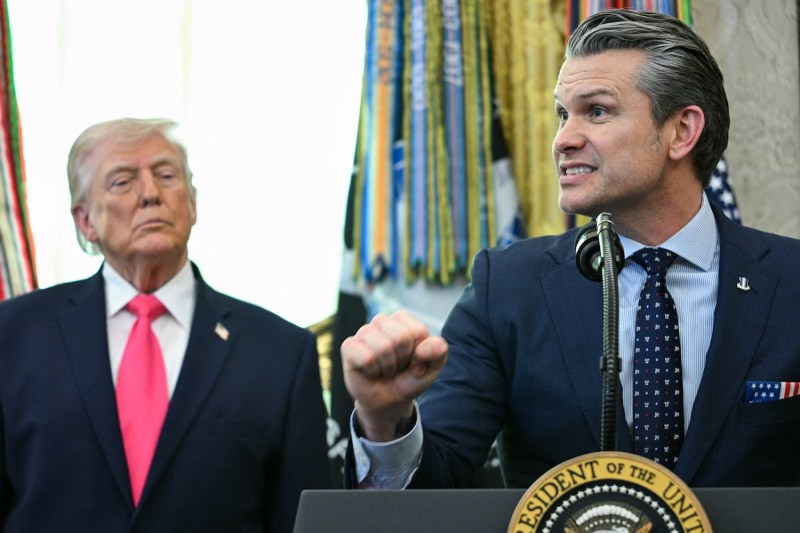
A former senior Pentagon official has publicly accused United States Secretary of Defense Pete Hegseth of having directed the commission of war crimes, as independent legal experts identify at least three categories of conduct by Hegseth that they say violate both domestic U.S. law and binding international treaty obligations. The accusations come as the civilian death toll from the U.S.-Israeli military campaign against Iran continues to rise, and as a preliminary Pentagon report has determined the United States was the most likely party responsible for a missile strike that killed more than 165 civilians at an elementary school on the first day of the conflict.
The accusation came on 25 March 2026 from Wes J. Bryant, a retired U.S. Air Force Master Sergeant who until September 2025 served as chief of civilian harm assessments at the Pentagon’s Civilian Protection Center of Excellence. Bryant told Democracy Now!: “Pete Hegseth has already directed the committing of war crimes. And unfortunately, our senior military leadership is bending the knee and carrying out whatever he tells them to do.”
The Pentagon did not respond to a request for comment.
WHO BRYANT IS AND WHY HIS ACCUSATION CARRIES INSTITUTIONAL WEIGHT
Bryant is not a political operative or an outside observer. He is an Air Force combat veteran with a career specialism in precision warfare, targeting doctrine, and civilian harm mitigation. His institutional role gave him direct visibility into both the policy architecture that Hegseth systematically dismantled from February 2025 onward, and into the operational commands in which harm-mitigation teams were embedded, including the Special Operations Command then under Admiral Frank Bradley.
According to ProPublica, which reviewed Bryant’s internal briefing notes from a December 2025 session with aides of Senator Chris Van Hollen, Bradley had at the end of 2024 described himself as “incredibly supportive” of the CHMR framework and had directed what the notes describe as “comprehensive lookbacks” on civilian casualties following errant strikes, mandating changes based on the findings.
Bryant did not resign quietly. He first attempted to reframe the programme in terms Hegseth might find acceptable, at one point proposing it be renamed the “Center for Precision Warfare.” That attempt failed. He then spoke to the Washington Post and the Boston Globe to warn publicly about the programme’s elimination. He was placed on administrative leave. His security clearance was threatened with revocation. He formally resigned in September 2025 and has spoken out in columns, television interviews, and congressional staff briefings since.
His warnings preceded the events he is now describing. In April 2025, Bryant asked publicly: “Is this administration now going to try to change the warfighting culture and doctrinal standards of the U.S. military, and have us executing our next conflict more like Israel has carried out in Gaza? If we do get into a large-scale conflict, will we not care one way or another about the civilian populace? Will our current low tolerance for civilian casualties and historically conservative application of proportionality under international law be completely reversed?” The conflict he was warning about began on 28 February 2026.
THE SYSTEMATIC DISMANTLEMENT: WHAT WAS REMOVED AND IN WHAT ORDER
The sequence of institutional decisions Hegseth made before the Iran conflict opened is directly relevant to the legal analysis of what has occurred during it. Legal accountability for command failures under international humanitarian law requires establishing that the responsible commander either knew violations were occurring and failed to prevent them, or created conditions that made violations foreseeable. The documented record of Hegseth’s decisions between January and March 2025 addresses that question directly.
The Civilian Harm Mitigation and Response programme, known as CHMR, was established under a 2022 Pentagon action plan and a formal Department of Defense Instruction, DoDI 3000.17, signed by then-Secretary Lloyd Austin. It comprised approximately 200 personnel at peak operation, including around 30 at the Civilian Protection Center of Excellence. Harm-mitigation teams were embedded with regional combatant commands worldwide, including at CENTCOM, which oversees operations across the Middle East. The Army also maintained CHMR personnel at every major command. The framework had bipartisan congressional support and was funded through congressional appropriations.
On 20 February 2025, Hegseth announced an 8 percent reduction to programmes outside 17 designated priority areas, with a stated emphasis on cutting what he called “non-lethal programs.” The CHMR programme and its associated Center of Excellence were designated for elimination. Bryant confirmed in a contemporaneous statement that “there is an overt and ongoing effort to completely shut the Center down and to remove CHMR across all the commands,” adding: “Basically, they are wiping DoD of anything related to Civilian Harm Mitigation and Response.”
Separately, Hegseth replaced the top lawyers for each military service branch. His stated rationale was that he wanted lawyers who provide “sound constitutional advice and don’t exist to attempt to be roadblocks to anything.” The military’s judge advocate general corps, which carries institutional responsibility for identifying unlawful orders before they are executed, was thereby politically weakened at the command level before the conflict began.
The Army subsequently made law-of-war training optional for personnel, describing mandatory instruction in prohibited battlefield acts, rules of engagement, and humanitarian law as an “unnecessary distraction” from what it termed “decisive action in combat.”
The Department of Defense also loosened rules of engagement to allow CENTCOM and other combatant commands to authorise strikes without White House sign-off. A Senate letter to the Pentagon dated 24 April 2025, reviewed by Spooky Connections, cited multiple current and former officials in describing the change as removing “necessary checks and balances on crucial life-and-death decisions.”
One current Pentagon official told The Intercept at the time that the direction of travel under Hegseth could indicate something beyond rhetorical posturing: the official worried about “wanton killing and wholesale destruction and disregard for law.”
THE SIGNAL DISCLOSURE: CLASSIFIED INFORMATION AND THE INSPECTOR GENERAL
On 15 March 2025, Hegseth used the commercial messaging application Signal to transmit operational information relating to planned U.S. airstrikes on Houthi targets in Yemen to at least two group chats. One of those chats included his wife, his brother, and his personal lawyer. An Atlantic editor, Jeffrey Goldberg, was inadvertently included in a separate chat containing the same operational details.
The Pentagon Inspector General transmitted a classified report to Congress on 3 December 2025. The unclassified summary stated: “Based on our review, we concluded that some information the Secretary sent from his personal cell phone on Signal on March 15, 2025, matched the operational information USCENTCOM sent and classified as SECRET//NOFORN.” The designation SECRET//NOFORN means the information was classified Secret and was not authorised for release to foreign nationals. The report found Hegseth violated Pentagon policy on the use of personal devices for official communications and that the disclosure risked endangering U.S. servicemembers.
Hegseth refused to sit for an interview with investigators and submitted only a written statement. He told the Inspector General he believed the investigation was “political” and that he lacked faith in acting Inspector General Steve Stebbins. He described the findings as “a total exoneration.” The Inspector General did not use that characterisation in the report.
A national security damage assessment, which is standard procedure following any unauthorised disclosure of classified defence information, was not conducted. CNN reported, citing multiple current and former officials, that no assessment was ordered in part because Hegseth declined to authorise one. Under previous administrations, former national security prosecutors told CNN, such an assessment would have been initiated as a matter of routine regardless of the disclosing official’s own willingness to cooperate.
Following the Signal story, Hegseth directed internal efforts to identify personnel he believed were leaking to the press and threatened to polygraph Department of Defense officials. Multiple current and former officials described the resulting atmosphere as a “chilling effect” on anyone who might speak internally or externally about his conduct.
An Air Force colonel was separately charged during the same period with sharing classified defence information with an unauthorised person via personal devices. That individual pleaded guilty to one count of unauthorised communication of national defence information and faces up to ten years in federal prison. The disparity in treatment between that case and the Hegseth Signal disclosure is documented and has been the subject of congressional comment.
THE CARIBBEAN BOAT STRIKES: THE SEPTEMBER 2025 INCIDENTS
On 2 September 2025, U.S. Special Operations forces struck a vessel in the Caribbean Sea believed to be carrying narcotics. After the initial strike, two survivors were found in the water. A second strike was ordered. Both survivors were killed.
The Washington Post reported, citing two people with direct knowledge of the operation, that Hegseth had issued a verbal order to “kill everybody” before the operation began, and that Admiral Frank Bradley, then head of the Joint Special Operations Command, ordered the second strike in what sources described as compliance with that directive. Hegseth denied the report, calling it “fake news.” The White House initially attributed responsibility for the second strike to Bradley, then, through press secretary Karoline Leavitt, stated that Bradley had been operating under Hegseth’s orders, an inconsistency that drew bipartisan criticism including from Republican senators.
By December 2025, U.S. forces had conducted at least 22 such boat strikes in the Caribbean and eastern Pacific, killing a total of 80 people. No public evidentiary record has been produced confirming that any of the targeted vessels were confirmed narcotics carriers at the time of the strikes. Many military law experts cited by Slate and other publications stated that the U.S. was not legally at war with any entity operating those vessels, meaning the strikes could not be characterised as lawful military operations under either domestic or international law, irrespective of the specific orders issued.
Under the Geneva Conventions and the laws of armed conflict, killing combatants or civilians who are unable to defend themselves, including survivors of a vessel strike clinging to wreckage, is prohibited regardless of their prior status. Under the UCMJ and 18 U.S.C. § 2441, such killings, if conducted during military operations, constitute federal crimes.
The Pentagon’s own artificial intelligence platform, deployed to all DoD personnel in December 2025, was reported by Above the Law to have assessed a “hypothetical” scenario matching the verified facts of the September 2 strike. It returned a finding that the described conduct would be “unambiguously illegal.” The Pentagon did not dispute the finding.
THE MINAB SCHOOL STRIKE: 28 FEBRUARY 2026
On 28 February 2026, the first day of Operation Epic Fury, the U.S.-Israeli military campaign against Iran, a missile struck an elementary school in Minab, a city in Hormozgan Province in southeastern Iran. Iranian health authorities reported a death toll exceeding 165, the majority aged under 12, with approximately 100 additional wounded. Photographs of the aftermath showed crushed school furniture, blood-stained backpacks, and rows of small coffins.
A Pentagon preliminary report subsequently determined the United States was the most likely responsible party. Senators Chris Van Hollen and Elizabeth Warren cited the findings in a joint public statement. Warren described the victims as “mostly little girls between the ages of seven and fourteen.” Van Hollen called for Hegseth’s immediate dismissal, stating the strike had occurred “at a time when Secretary Hegseth has systematically weakened US protections against civilian harm by our military.”
Human rights organisations including Amnesty International issued statements calling the strike a possible war crime requiring independent investigation. Representative Rashida Tlaib stated there was “more than enough evidence” to conclude U.S. forces were responsible.
Bryant described the Minab strike as “not a case of fog of war” and said it was “pure and complete negligence,” adding it was “representative of a pattern of this de-evolution of these standards and practices that the U.S. military has been upholding and condoning, up until Hegseth took the reins.” As of 25 March 2026, Bryant’s former colleagues at the civilian casualty monitoring organisation Airwars were tracking more than 130 separate civilian casualty incidents from combined U.S. and Israeli strikes across Iran since the campaign began. The total confirmed Iranian death toll from the conflict stood at more than 1,400 at that date, with millions displaced.
No public accountability process for the Minab strike has been announced by the Pentagon. No targeting authority chain has been made public. No post-strike review has been confirmed.
THE “NO QUARTER” DECLARATION: THE STATEMENT AND ITS LEGAL CONSEQUENCES
On 13 March 2026, thirteen days into Operation Epic Fury, Hegseth told reporters at a Pentagon briefing: “We will keep pressing. We will keep pushing, keep advancing, no quarter, no mercy for our enemies.”
The legal meaning of “no quarter” in the laws of armed conflict is specific, documented, and uncontested. It means the refusal to accept surrender and the killing of combatants who attempt to lay down arms. The declaration of “no quarter,” or the threat to conduct operations on that basis, has been prohibited under the Hague Convention IV since 1899, specifically under Article 23(d), which states it is “especially forbidden to declare that no quarter will be given.” The prohibition is codified in Geneva Conventions Additional Protocol I, Article 40. It is incorporated into U.S. federal law under the War Crimes Act of 1996, 18 U.S.C. § 2441(c)(2). The U.S. military has prohibited such orders since President Abraham Lincoln issued the Lieber Code in 1863 during the Civil War. The prohibition was applied at Nuremberg, where senior German military officials were prosecuted specifically for denying quarter to enemy combatants.
The Pentagon’s own law-of-war manual states the prohibition explicitly. The U.S. Marine Corps rules of engagement state: “Do not engage anyone who has surrendered or is out of battle due to sickness or wounds.”
Brian Finucane, a former State Department lawyer and senior adviser at the International Crisis Group, stated: “Denying quarter is a war crime and recognized as such by the United States. The mere announcement of a no-quarter policy from a government official can itself be a war crime.”
Ryan Goodman, a former Defense Department general counsel official and founding co-editor of Just Security, said: “The Pentagon’s law of war manual states unequivocally that such statements are war crimes. Hegseth is putting the American military on a track to lawlessness in which we will lose more and more allies.”
Oona Hathaway, a legal scholar and former special counsel to the Pentagon’s general counsel, stated that declaring no quarter will be given is explicitly prohibited under the rules Hegseth is bound by as Secretary of Defense.
Daniel Maurer, a retired Army lieutenant colonel, judge advocate, and associate professor at Ohio Northern University College of Law, published a formal legal analysis on 14 March 2026 structured as the memorandum the Pentagon General Counsel would be obligated to deliver. He identified three possible interpretations of Hegseth’s statement and found that all three exposed him to criminal liability. Under the first interpretation, that Hegseth did not know the legal meaning of “no quarter,” the statement would still be construed under law as counselling, commanding, or threatening the commission of a war crime. Under the second, that he knew its legal meaning but intended it rhetorically to intimidate Iranian forces, Maurer found this “still could be considered a war crime.” Under the third interpretation, that Hegseth knew the meaning and intended it as a command to subordinates, Maurer stated: “This would absolutely be the textbook definition of a war crime.” Maurer warned that any subordinate who executed such an order would face prosecution under the UCMJ and could not raise a superior-orders defence, as the order is “patently” or “manifestly” unlawful.
Maurer’s conclusion: “We’re left to trust that they’re not going to interpret what he said as a command. And if they do think of it as a command, then we have to trust them to disobey it.”
Senator Mark Kelly of Arizona, a retired U.S. Navy captain, stated: “No quarter isn’t some wannabe tough guy line. It means something. An order to give no quarter would mean to take no prisoners and kill them instead. That would violate the law of armed conflict. It would be an illegal order. It would also put American service members at greater risk.”
Senator Mark Warner of Virginia, ranking member of the Senate Intelligence Committee, said: “The U.S. is party to the Geneva Conventions and bound by international humanitarian law. Whether it’s the secretary’s comments this morning, or his assertion that the military won’t be governed by what he terms stupid rules of engagement, rhetoric like this is unacceptable and actually endangers U.S. service members.”
A dissenting interpretation was offered by Marko Milanovic, professor of international law at the University of Reading, who said the statement could represent “Trumpian hyperbole” rather than a literal operational directive and that the no-quarter prohibition applies specifically when a commander directs subordinates not to accept surrender in the field. However, Milanovic’s interpretation represents the most charitable possible reading of the statement, and legal experts at Just Security, the International Crisis Group, Ohio Northern University, and former counsel to the Pentagon’s general counsel have each, independently, declined to adopt it.
Hegseth did not retract the statement. The Pentagon did not issue any clarification to the chain of command stating the remark was not intended as an operational directive.
THE SPECIFIC CRIMES: A LEGAL ACCOUNTING
The allegations against Hegseth, as they stand on the documentary record as of 26 March 2026, span three distinct categories of conduct and implicate both international treaty law and domestic U.S. criminal statute.
The first category is the unlawful killing of persons rendered unable to fight. The killing of two survivors of the September 2025 Caribbean boat strike, if carried out under Hegseth’s verbal order, constitutes a violation of Common Article 3 of the Geneva Conventions, which prohibits “violence to life and person” against individuals who are hors de combat, meaning unable to fight. It additionally constitutes a potential violation of 18 U.S.C. § 2441(c)(1), which incorporates grave breaches of the Geneva Conventions into U.S. federal criminal law, and a violation of Article 23(c) of the Hague Convention IV, which forbids killing or wounding an enemy who has surrendered or is disabled. If the operations are deemed non-military in character because no lawful state of armed conflict existed with the vessel operators, the killings would fall entirely outside the combatant immunity framework, constituting murder under applicable federal statutes. The maximum sentence under the War Crimes Act where death results is death or life imprisonment.
The second category is the unlawful killing of civilians through disproportionate or indiscriminate attack. The Minab school strike, as assessed by the Pentagon’s own preliminary report as likely a U.S. action, constitutes a potential violation of Article 51 of Additional Protocol I of the Geneva Conventions, which prohibits indiscriminate attacks likely to cause disproportionate civilian casualties, and of Article 57, which requires precautions in attack including civilian casualty estimation. It is potentially a grave breach of the Fourth Geneva Convention under Article 147, which includes “extensive destruction and appropriation of property, not justified by military necessity and carried out unlawfully and wantonly” and “willfully causing great suffering or serious injury to body or health” as defined war crimes. Under 18 U.S.C. § 2441, the definition of war crime includes grave breaches of all four Geneva Conventions. The elimination of the CHMR framework, which was specifically designed to produce pre-strike civilian casualty assessments, is directly relevant to whether the precautions mandated under Article 57 were taken.
The third category is the declaration of no quarter. Under 18 U.S.C. § 2441(c)(2), the War Crimes Act incorporates violations of the laws and customs of war as defined by the Hague Convention IV, including Article 23(d), which explicitly prohibits declaring that no quarter will be given. Under this statute, the speech act of declaring no quarter is itself a criminal offence, regardless of whether the declaration is subsequently executed in the field. The statute provides that where death results from conduct under the War Crimes Act, the penalty may include death or life imprisonment. Where death does not directly result, the penalty is imprisonment for any term of years. Criminal liability under 18 U.S.C. § 2441 extends to any U.S. member of the armed forces and to any U.S. national, a category that encompasses the Secretary of Defense.
Additionally, by removing the military’s senior lawyers before the conflict began, and by making law-of-war training optional, Hegseth eliminated the two institutional mechanisms most directly responsible for preventing the execution of unlawful orders before they reach the battlefield. Command responsibility doctrine under international humanitarian law, codified in the Rome Statute of the International Criminal Court at Article 28 even though the United States is not a party, and reflected in customary international law binding on all states, holds that a military commander is criminally responsible for crimes committed by subordinates if the commander knew or should have known the crimes were being committed and failed to take necessary and reasonable measures to prevent them. The documented dismantlement of civilian protection and legal oversight infrastructure is directly probative of that element.
THE FORMER JAGS WORKING GROUP FINDING
The Former JAGs Working Group, an organisation of former and retired military judge advocates founded in February 2026, issued a formal statement finding that specific conduct carried out under Hegseth’s command constituted, in their collective legal assessment, “war crimes, murder, or both.”
The group issued a separate statement finding that Hegseth’s move to initiate an investigation of Senator Mark Kelly of Arizona after Kelly posted a video reminding servicemembers of their duty to disobey unlawful orders constituted a violation of military law. They stated the command pressure exerted by Hegseth and Trump would likely disqualify all convening authorities from referring any case against Kelly to court-martial, “except possibly the president himself,” a finding that itself underscores how thoroughly the military justice oversight architecture has been subordinated to civilian political pressure.
Kelly stated publicly: “It wasn’t enough for Donald Trump to say I should be hanged, which prompted death threats against me and my family. It wasn’t enough for Pete Hegseth to announce a sham investigation on social media. Now they are threatening everything I fought for and served for over 25 years in the U.S. Navy, all because I repeated something every service member is taught.”
THE STATUS OF FORMAL PROCEEDINGS
As of 26 March 2026, no criminal investigation under 18 U.S.C. § 2441 or the UCMJ has been publicly confirmed as open or active regarding any of the conduct described in this report.
Whether Bryant’s public accusation has been formally transmitted to the Pentagon Inspector General through a protected whistleblower channel is not confirmed. Whether the Senate and House Armed Services Committees have received formal notification of a war crimes allegation against the Secretary of Defense is not confirmed. Whether any post-strike accountability review of the Minab school strike has been initiated is not confirmed. Whether the targeting authority chain for that strike, the rules of engagement in force at the time, and the pre-strike civilian casualty assessment conducted, if any, have been transmitted to congressional oversight committees is not confirmed.
The Inspector General’s office is led by Steve Stebbins in an acting capacity. He has not been confirmed by the Senate. His independence from political pressure has been a documented concern in congressional proceedings. Hegseth has publicly stated he lacks faith in Stebbins. The Inspector General who found that Hegseth risked endangering U.S. servicemembers with the Signal disclosure saw those findings described by Hegseth as a “total exoneration.”
Requests for comment submitted to the Pentagon Inspector General’s office, the Senate Armed Services Committee, the House Armed Services Committee, and the Department of Defense Office of General Counsel are outstanding. No response has been received.
CONCLUSION
What the documentary record establishes, as of 26 March 2026, is this. A Secretary of Defense with a documented and publicly stated ideology of contempt for the laws of war and the institutional mechanisms designed to enforce them spent the first months of his tenure systematically eliminating those mechanisms. He removed the lawyers responsible for flagging unlawful orders. He made law-of-war training optional. He eliminated the programme specifically designed to prevent disproportionate civilian casualties. He loosened targeting authority to remove the requirement for White House sign-off on strike decisions.
He then, before any of these structural changes had been assessed by Congress or subject to any accountability proceeding, oversaw the commencement of a military campaign in which a school full of children was struck on the first day, in which more than 130 civilian casualty incidents have since been recorded, and in which he publicly declared, at a Pentagon press briefing, that U.S. forces would give “no quarter, no mercy” to their enemies. That declaration has been independently assessed by a former State Department lawyer, a former Pentagon general counsel official, a retired Army judge advocate and law professor, a former special counsel to the Pentagon’s general counsel, and a coalition of former and retired military judge advocates as constituting a war crime under both U.S. federal law and the treaties the United States has ratified.
No prosecution has been initiated. No retraction has been issued. No damage assessment for the classified Signal disclosures has been conducted. The conflict continues, with no defined endpoint, at the Secretary’s own statement, and at the president’s discretion.
The named whistleblower is on record. The legal framework is documented. The sequence of institutional decisions is dated and attributed. What remains absent is accountability.
Citations
Wes Bryant, Democracy Now!, 25 March 2026: https://www.democracynow.org/2026/3/25/wes_bryant
ProPublica, “The U.S. Built a Blueprint to Avoid Civilian War Casualties. Trump Officials Scrapped It,” March 2026: https://www.propublica.org/article/trump-defense-department-iran-hegseth-civilian-casualties
The Intercept, “Pete Hegseth Is Gutting Pentagon Programs That Reduce Civilian Casualties,” April 2025: https://theintercept.com/2025/04/15/pete-hegseth-pentagon-civilian-casualties-harm/
Pentagon Inspector General Report on Signal Use, NPR, 3 December 2025: https://www.npr.org/2025/12/03/nx-s1-5630519/signalgate-pete-hegseth-inspector-general-report
CNN, Pentagon did not conduct Signal damage assessment, 11 December 2025: https://www.cnn.com/2025/12/11/politics/pentagon-did-not-conduct-hegseth-signal-investigation
Daniel Maurer, Just Security, “Hypothetical Legal Advice to SecDef Hegseth on No Quarter Statement,” 14 March 2026: https://www.justsecurity.org/133970/legal-advice-hegseth-no-quarter-hypo/
Axios, “Hegseth’s No Quarter Iran Talk Alarms Legal Experts,” 15 March 2026: https://www.axios.com/2026/03/15/trump-hegseth-iran-war-no-quarter
HuffPost, “Secretary of Defense Hegseth Promises Iranians No Quarter, A War Crime,” 13 March 2026: https://www.huffpost.com/entry/hegseth-no-quarter-war-crime_n_69b44e2fe4b0676e64bf4b04
Al Jazeera, “Analysts say US threat of no quarter for Iran violates international law,” 14 March 2026: https://www.aljazeera.com/news/2026/3/14/analysts-say-us-threat-of-no-quarter-for-iran-violates-international-law
The Intercept, “My Quest to Make the Pentagon Care About the Crimes It Covered Up,” 27 December 2025: https://theintercept.com/2025/12/27/pete-hegseth-mark-kelly-investigation-vietnam/
Slate, “Pete Hegseth Is Accused of War Crimes. Now Trump Faces a Fateful Choice,” 2 December 2025: https://slate.com/news-and-politics/2025/12/pete-hegseth-trump-war-crimes-boats-venezuela.html
Common Dreams, “Pete Hegseth Needs to Be Fired Immediately,” March 2026: https://www.commondreams.org/news/pete-hegseth-fired
18 U.S.C. § 2441, War Crimes Act 1996: https://www.law.cornell.edu/uscode/text/18/2441
Senate letter to Pentagon on CENTCOM rules of engagement and civilian casualties, April 2025: https://www.kaine.senate.gov/imo/media/doc/yemen_civcas_letter.pdf